Matthew Barney and Jonathan Bepler’s River of Fundament took over Masonic Hall in New York City on November 14, produced by the New People’s Cinema Club as part of the Unsound Festival. This was only the second screening of River of Fundament in NYC since its 2014 premiere at Brooklyn Academy of Music. The eight-hour event included a full screening of the 330-minute operatic film, two intermissions with food (catered by White Castle!) and drinks, live music in the form of musical interjections by Jonathan Bepler and colleagues, a touching and elegiac introduction by Matthew Barney remembering departed cast and crew, and a continuous sense of excitement in the air. The atmosphere was more that of a live concert-cum-convocation than a film screening.
By the time the doors opened to start the event, the line stretched around two corners of the city block. It was sold out with reportedly over 800 attendees. The choice of venue was appropriate, given the Masonic themes in 2002’s Cremaster 3, featuring the character of the Entered Apprentice portrayed by Barney. As a nod to Cremaster 3, for Barney’s portrayal of the Ka of Norman in River of Fundament, he wore a decrepit version of the same Entered Apprentice uniform. (Ditto Aimee Mullins‘s portrayal of Isis in River of Fundament echoing her Entered Novitiate in Cremaster 3.) Additionally, the Egyptological references throughout River of Fundament nicely befitted a Masonic setting. In addition to Barney and Bepler, members of the crew were also in attendance (e.g., cinematographer Peter Strietmann), as well as musicians from the film. I also saw Secondary‘s Raphael Xavier, among other notables—a real Who’s Who of the greater Barney universe.
The Grand Lodge Room was transformed into a theater, and between the stage and seats was a makeshift pit for the musicians to augment the score throughout the screening. Jonathan Bepler led and performed with the ensemble of Mick Barr, Sam Bishoff, Eric Hubel, and Megan Schubert (also of Redoubt). (Barr, Hubel, and Schubert also appear throughout the film.) The program began with a musical invocation of organ and ambulatory winds. After several minutes, over a live musical bed, Barney took the stage to read the names of late members of the cast and crew. After his solemn remembrance, the film began. The ensemble took to the pit and performed throughout much (but not all) of the film. Some parts were faint complements (e.g., dripping or sloshing water), and others were more interactive (e.g., additional instrumental or vocal resources to augment the existing score). The so-called interjections were tasteful, from subtle murmurations to cacophonous gestures. Much of River of Fundament‘s music emerges organically out of the diegetic sonic environment (e.g., instruments tuning up at the wake, bleeding radiators, etc.), so having a live element to complement what’s on the screen and in the speakers made for a rich sonic experience.
The live musical invocation before each act was related to the material in some way. The whistles and other winds plus organ before the first act were reminiscent of some of the wake’s more worldly characteristics before the spirits begin to fully replace the wake guests. The second act’s invocation included strings and voice, before both the metalin-backed vocal aria at the beginning of KHU (the live performance in Detroit) as well as some of the more frenzied transitional wake passages. And the low horns before Act III were a nod to those used in BA (the live NYC performance).
As mentioned above, the audience’s energy and interest throughout the afternoon and evening were palpable. From what I could tell through my own conversations and what I heard from others, most attendees hadn’t seen the film before but were actively interested, and the audience broke into applause after each act, with many staying through the most of the credits. The difference between Saturday and my first viewing experience couldn’t have been more stark. I remember there being ~75 people at the 2016 screening I attended at the Cleveland Institute of Art, and there was heavy attrition throughout. There were a handful of us that lasted the duration, and the room felt utterly deflated. (I felt completely out of place having had a nearly transcendent experience.) While the audience reduced some after each act last weekend, most of the crowd stayed until the end, enthusiastically.
River of Fundament was even better this second viewing. I have many thoughts on that specifically, though I’ll save those for a separate post. (My initial take from a decade ago holds up.) Suffice it to say, after ruminating on the film in my mind’s eye and ear for a decade, it was wild—and cathartic—seeing it again.
The next day featured a discussion with Matthew Barney and Jonathan Bepler led by ARTnews and Art in America executive editor Andy Battaglia. The talk, part of the Durations Festival, was held in an intimate space at Brooklyn’s Public Records. I was looking forward to Mr. Battaglia’s moderation, as he’s written wonderfully about Barney in the past, including about River of Fundament specifically. He delivered, dealing with the film as an operatic work, which is to say a marriage of music and drama. (Finally, someone did it!) He centered both the sonic and the visual elements, and the resulting discussion and anecdotes from Barney and Bepler were informative and compelling.
Given my keen interest, I’ve watched, read, and listened to the various interviews with Barney alone or Barney with Bepler over the years, and many of the interviews fall into a couple of traps: a narrow focus on the visual at the expense—and nearly omission of—the sonic; and/or an attempt to engage Barney on whether it’s a Gesamtkunstwerk1, which Barney has repeatedly rejected. I was relieved it wasn’t uttered once. The discussion ran the gamut from their work on River of Fundament specifically to their collaboration broadly. Their iterative process is as much about reacting to one another’s ideas through their own respective medium as it is any sort of collective creation. And, though I won’t name names, it was a treat to hear some of the behind-the-scenes anecdotes.
Yes, I’m a Wagnerian and have used the term when discussing Barney’s work, but it seems to be the one operatic term that people deploy when trying to tackle this work, with little else beyond that. Beyond the G-word, I thought I heard a Wagnerian reference in Redoubt which has stayed with me. Alas, I didn’t ask Bepler about it when I had the chance. ↩︎
Secondary comes four years after Matthew Barney’s last large-scale exhibition, 2019’s Redoubt. Like its predecessor, Secondary features movement-based narrative in addition to materials- and aural-based elements. It’s also short (for Barney): one hour, though it does benefit from multiple viewings. Here Barney again collaborates with composer Jonathan Bepler. Also, notably, top creative billing is shared with movement director David Thomson, indicating the enhanced importance of dance and movement to Secondary compared to Barney’s earlier pieces.
Secondary maps two different narratives onto each other, using movement as the formal through-line. The first describes the complex overlay of violence and spectacle inherent in American football, and more broadly within American culture. Barney’s personal involvement in the sport served as a starting point for the development of this project. The extreme physical and psychological conditions of the game have been abstracted in Barney’s art practice since his earliest work, and now provide a context for this subject that is both retrospective and a new, direct engagement.
The significant risk of the game became clear, and made a lasting impression on Barney as a young player, through an incident that took place in a professional football game on August 12, 1978 where Jack Tatum, a defensive back for the Oakland Raiders, delivered an open field hit on Darryl Stingley, a wide receiver for the New England Patriots. Stingley was left paralyzed. The impact, and Stingley’s resulting catastrophic injury, became mythic in scale through its relentless replay in sports media. It was also a watershed case for the reform of rules protecting the bodies of athletes, which remains a polemic in football today, now gathering critical mass in the media. Secondary’s underlying plotline examines these charged aspects of football—and, specifically, Barney’s memory of that play in 1978—through a movement vocabulary that focuses on each element of the game, from drills to pre-game rituals to the moments of impact. It seeks to explore the complicated overlay of actual violence and its currency as image within the sport and the culture at large.
The parallel narrative in Secondary is a material-based choreography where the substances Barney uses to make sculpture—lead, aluminum, terracotta, and plastic, all in various states of liquidity—are generated, formed, and manipulated by the performers in real time. These materials speak to qualities of strength, elasticity, fragility, and memory, and each, in its own way, embodies a character. The athletes cast in Secondary are played by professional dancers and by Barney, and they range broadly in age, but with an emphasis on older bodies.
Secondary was filmed in and around Barney’s warehouse studio, which also serves as the exhibition space. Between producing the work and opening the space for public exhibition, the studio has been cleared of tools, materials, and associated ephemera, leaving an open expanse that more resembles an athletic facility than an atelier. While viewing the film, one sees an earlier version of the same site put to different use. Mr. Barney has demurred in the past when repeatedly presented with the prospect of River of Fundament(and other works) being examples of gesamtkunstwerk (“total work of art”), principally because Barney also associates that term with the artist building the “container” in which the work is presented—his primary example being Richard Wagner’s Bayreuther Festspielhaus, which was built to the composer’s specifications and exclusively stages his works to this day. That said, while Barney didn’t build the warehouse in which Secondary was filmed and presented, he is responsible for manipulating said container to meet his purposes. Per his stated usage of the term, Secondary comes much closer to realizing a gesamtkunstwerk than his earlier pieces. (Whether or not he would agree with that is another matter. Probably not.)
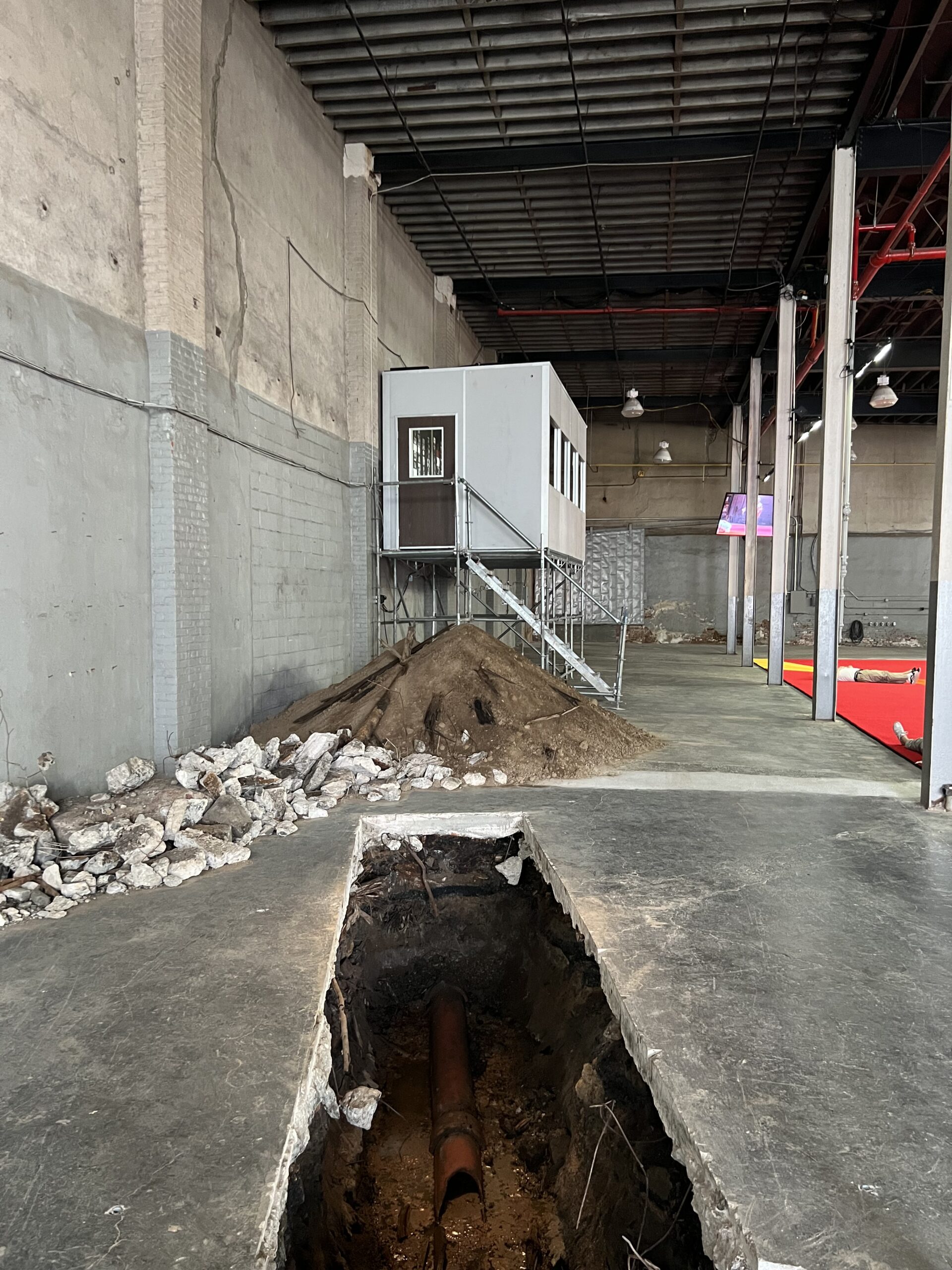
Amid the vast gray setting of steel, concrete, and support columns is a large, strikingly colorful field of artificial turf, in the center of which is the Field Emblem, an idée fixe from throughout Barney’s oeuvre that in the past he has specifically related to football. Hanging above the field is a three-sided jumbotron, similar to that which one would see at a professional sporting event. Additional screens are also placed near each of the field’s corners, much like the screens placed throughout an arena or stadium. Floodlights are mounted to establish the field as the central focal point. To one side is a makeshift press box of sorts and to the other is a row of benches. Viewers are welcome to watch the screens from the field, the benches, or to walk around and change perspective throughout the 60-minute duration (the length of a football game, without breaks or stoppages).
The film plays across five screens simultaneously: the jumbotron shows the same feed on each of its three sides, and the other four screens vary throughout—sometimes showing different perspectives of the same scene, sometimes showing different scenes entirely, and other times synchronizing either in pairs or across four or all five screens. Hence the film promoting repeated viewings. I was present for multiple screenings and saw several new things each time. Additionally, each screen has its own sound feed, adding another layer that phases in and out of sync.
Viewers watch in the arena / exhibition space
Though abstracted, familiar rituals play out. First we see the various participants prepare: athletes train and warm up; the owner facilitates the site; fans excitedly await the game; referees consult one another; everyone gets in place (the teams and referees take the field; the owner goes to the press box; fans gather around); the national anthem is given focused attention; the game is played; the fans leave; the site resets for the next contest. The assorted preparations constitute a majority of the film, but they gradually build narrative tension, as the viewer knows that the game and injury will eventually occur, but not when or how. Also, it’s not unlike a real athletic regimen: most of the time is spent in preparation and maintenance—training, running drills, practicing maneuvers—and is punctuated by the occasional game (or race or event, etc.), particularly in professional American football which follows a roughly weekly game schedule during its regular season.
Throughout approximately the first half of the film, bodies work solo, in concert with one another, and in dialogue with materials. Various actions, from routine movements such as throwing a ball and assorted calisthenics to repetitive head trauma, are deconstructed by performers David Thomson, Shamar Watt, Raphael Xavier, Wally Cardona, Ted Johnson, and Matthew Barney. Similarly, numerous materials are physically engaged: tubing, garbage bins, polycaprolactone (PCL), clay, a muddy trench. Just as a game showcases, at least in part, much of the preparation that has gone into it, the game in Secondary—including the national anthem as the opening act— is where all of the pieces come together. It features movement (solo and in concert), music (solo and in concert), and materials (in various stages of rigidity). The game is also the first time we see all performers (athletes, officials, fans, etc.) in the same space and interacting to some degree as a group. Tension is heightened by finally bringing the two teams into direct confrontation, as they’ve been presented as training separately up until this point (though all within the studio and sometimes near one another).
One noteworthy fact about the the six performers who portray the athletes is that most of them don’t have backgrounds playing football. (Barney, who played football while at Yale, has woven athleticism generally and football specifIcally through much of his output.) I highlight this because Barney generally prefers practitioners over actors—in this case, one would assume a football player. That said, by selecting movement artists, the performers were able to home in on specific movements and actions divorced from the context of a specific game or sport. A film ostensibly about football, at least in one regard, does not show a literal sequence one would see in an actual game of football, yet it powerfully conveys a message about such all the same. (I’m reminded of Wagner’s Die Meistersinger von Nürnberg, an opera about a song contest yet lacking a single unbroken aria.) However because the game is so ubiquitous in America, most people have at least a passive familiarity with the sport, its presentation, and its actions. Secondary does include one actor: Thomas Kopache as Raiders owner Al Davis. His expressive gaze haunts the film, particularly during the national anthem.
Because the subject is so familiar, it can be approached indirectly and still be legible to a wider audience. Consequently, Secondary is the most accessible of Barney’s major works, at least in recent years. While not mainstream by any means, the subject matter, length, and overall presentation (playing in a loop in an open gallery) are likely to be more welcoming than scheduled screenings of feature-length (or longer) works about the cosmic hunt or bespoke Egyptian mythology or the like. While it does lack explicit imagery, a foreboding sense of violence—immediate, psychological, cultural—permeates much of the running time.
Composer Jonathan Bepler shapes a compelling sonic experience. Like Redoubt, the music and sound here are more complementary and decorative as opposed to a shared centerpiece, as with the operatic River of Fundament. However, a noteworthy change in Secondary is that, I believe, a vast majority of the music and sound has a diegetic source. (It may be occasionally treated after the fact, but “external” sounds are rare.) While there may be seemingly non-diegetic instances—e.g., hearing sounds from one screen while looking at another, or seeing vocalizations begin with one character while the camera cuts to another character—there is little-to-no semblance of an external score. As with the film and the site, the music is contained within the film’s universe itself. Save some percussive elements made corporeally or with found objects, much of the rest of the score is vocal, particularly in the vein of the free vocalizations found in River of Fundament and Redoubt. Several of the recurring vocal techniques mimic those found at a sporting event. Examples include: – Vocalizations to mimic the sound of a referee’s whistle, occasionally made by the performers portraying referees – Screaming and rasping reminiscent of a crowd’s cheers, often made by those portraying fans – Quick staccato utterances of “hut” and other syllables, often done by the referees when consulting one another – Groans and croaks redolent of an injured player
A pivotal scene dramatizes Barney’s dissection of the national anthem ritual. After the players and referees take the field, the owner ascends to the press box, and the fans gather around, soprano Jacquelyn Deshchidn, a Chiricahua Apache, adorned in gold and wearing wings, takes center stage (on or near the Field Emblem). Instead of singing “The Star-Spangled Banner,” Deshchidn performs an aggressive and mournful improvisatory piece lasting several minutes. Deceptively, their piece begins on “O,” but the similarities quickly end. Here Deshchidn is accompanied by the chorus of referees portrayed by Isabel Crespo Pardo, Jeffrey Gavett, and Kyoko Kitamura. Notably, this passage includes the only instance (lasting a couple of seconds at most) of consonant harmony throughout the whole film, occurring at approximately the 46-minute mark, and its rarity and unexpectedness yields a great impact. Deschchidn’s anthem also includes the lone clear word uttered in all of Secondary, “bombs,” which is repeated in quick succession at varying intervals and dynamics by both soloist and chorus. Throughout much of their performance, Deshchidn locks eyes with Kopache’s Al Davis as he glares down from the press box.
Deschidn during the anthem (Jerry Saltz watches, sans coffee)
It should be noted that this is the third successive major work that situates an Indigenous American character in a central role: Jacquelyn Deshchidn’s national anthem in Secondary, Sandra Lamouche’s hoop dance in Redoubt, and, among others, Chief David Beautiful Bald Eagle as Norman III (i.e., the version of Norman closest to being divine) as well as pow wow ensemble Mystic River in River of Fundament. Though representing different tribes and traditions, it’s no coincidence that Barney has centered the generally shared Indigenous American experience when exploring violence, mythology, nature, and industrialization in American contexts.
Signature Barney elements appear throughout the film. Plastics and metals are engaged in various states: viscous PCL handled by Watt and Cardona; dumbbells molded from clay and plastic; a triptych of sculptures resulting from the impacts between Thomas and Xavier recreating the Stingley-Tatum trauma. There are also references and allusions to earlier work. In one sequence, a pair of athletes engage a large salt block, such as those seen in River of Fundament. The trench itself, as well as Watt’s physical dialogue with the mud and the filth also have obvious parallels to River of Fundament. In addition to further exploring the boundaries of dance and movement highlighted in Redoubt, a sculpture from the same film is seen in the studio during an early sequence of Secondary. Of course, the concept of creating via movement and resistance is at the heart of Barney’s long-running Drawing Restraint series. The Field Emblem has permeated Barney’s work for decades, including being highlighted in Cremaster Cycle and Drawing Restraint 9, among others. And football has been a recurring subject and influence in his work going back to some of his earliest output such as Facility of DECLINE.
The current exhibition includes more than just the film. The site itself is, as Barney notes, a “central character” in Secondary, so one may move around the studio, including onto the field (and sit or lay if preferred). The trench remains and may be viewed up close. The press box, though closed off, still stands. Within it are a storyboard and a sculpture, possibly a water casting. A work on canvas, a take on the field of play featuring the Field Emblem, hangs on one wall of the studio. Bringing the show full circle, an Otto jersey is also displayed.
Trench, press box
I highly recommend Secondary if you have the opportunity. Although it may possibly screen elsewhere in future months or years, seeing the film where it was created—in the space adapted for that purpose—is a singular experience, one I’ll always treasure.