The event includes a public conversation the following day between Matthew Barney and Jonathan Bepler, moderated by Andy Battaglia. I should note that Mr. Battaglia, who is the executive editor of ARTnews and Art in America, is an excellent choice of moderator. He wrote a valuable review of River of Fundament published in The Paris Review in 2014. (As I noted here and elsewhere, many reviews were ill-informed, more than one of which I requested corrections to. Not in this case.)
As I noted here, seeing the 2016 screening of River of Fundament at MOCA Cleveland (after having seeing the exhibition at Munich’s Haus der Kunst in 2014) was a highlight of the decade.
I glancingly mentioned in this post that while I’m very active musically things have gone in unexpected directions in recent years: “more alto and less tenor, more clarinet and less flute, and much more jazz and almost no original music.”
The biggest change is that I’m playing a lot of jazz, both in ensembles and small groups. I wouldn’t have guessed that even three or four years ago, as I mostly stopped playing jazz gigs about a decade ago. More surprising, though, is that over the last ~18 months or so, alto has become my primary jazz horn in large ensemble contexts, such as lead alto in big bands (including The Anderson Big Band and Buffalo Jazz & Swing) and the like. Until recently, alto was my primary saxophone in only classical and pit orchestra contexts, and it was a secondary (at best) or tertiary horn in all other styles. But when opportunities arose and I was regularly asked to play alto and associated doubles, I’d say “yes,” and each “yes” led to another offer and acceptance, and so on. I regularly have long stretches during which I publicly play tenor the least behind alto, soprano, and baritone (usually in that order). It’s been a (mostly) fun challenge, though it can be stressful, as I don’t always consider it “home.” It remains shocking to learn that some people associate me with that horn.
Another development, one without qualms or qualifications, is my frequently playing soprano saxophone in public again. I’ve been digging into playing traditional jazz regularly with The Back Room Jazz Band (and occasionally others). It’s been a wonderful opportunity to both play that horn regularly (along with some clarinet, which is less enjoyable) outside of the house as well as play that style of music. It’s somewhat of a full circle moment, as traditional (i.e., Dixieland) jazz, hot jazz, and the like were some of the first styles of jazz I listened to regularly in high school thanks to faithfully tuning into Riverwalk Jazz every Sunday on terrestrial radio. (And I still listen to the archive hosted by Stanford University.) I’ve long been fond of that sound, but it’s rare to have an opportunity to play in a traditional instrumentation including tuba, banjo, and trombone. While I have a long way to go, regularly setting foot in that world has been rewarding. (A nice photo of The Back Room Jazz Band at the 2026 Lewiston Jazz Festival is at the top of this page.)
The increased clarinet playing has been tricky. I broke my foot several years ago and took the extra time I gained by not running for several months to consciously work to improve my clarinet chops. This was partially out of necessity, as I was getting more work for it. But also, I’ve never really enjoyed the instrument, so my goal was to dislike it less if nothing else. It’s since paid off, including even getting some work on bass clarinet (when doing big band work on bari) and Eb clarinet (pit orchestra), but it’s still a problematic relationship, albeit less than before.
I’ve done very little original music in recent years, but that’s okay, all things considered. While it’s something I’d like to explore again (in the right context), I only have so much time. Moreover, aside from known quantities with whom I’ve made music before, going down the original music or capital-B “Band” route with new folks can be daunting. I’m happy to be a regular sideman and/or hired gun.
The only thing I’m really missing is a regular classical outlet, but that’s not easy to come by as a saxophonist unless I work to create something, and I don’t have the bandwidth for such now. It’s nothing I’m losing sleep over. I’ve been able to get in through the side door here and there for some miscellaneous jobs, which is good enough at this juncture.
Other than a general update on musical activities, I suppose my point is that you never know what paths may arise. A few years ago, I assumed it was all rock/pop and ambient with the occasional pit and no jazz for the rest of the time, and now it’s an entirely different formula and balance.
It’s been over a decade since I last wrote a post dedicated to saxophonic gear. As I wrote then and I’ll reiterate now, I’m not a gearhead. I’m rarely interested in the latest gadget or who’s playing what. And I have yet to be in the market for a vintage horn.
All that said, I bought quite a bit of new auxiliary hardware the last several years to increase overall convenience, comfort, and efficiency. The end result was worthwhile, my distaste for the process notwithstanding. Spending all that time poring through product reviews, messages boards, and the like was vexing. Part of the frustration stemmed from a lack of specific information regarding several items. So, as a public service of sorts, I thought I’d write a post for anyone in a similar boat.
I wanted to compare how various instrument cases fared regarding storage, transport, and general usability. Many reviews focus primarily or solely on protection, which is understandably paramount, with occasional back-and-forth regarding the enclosure (latch vs. zipper, etc.). The second salient factor tends to be compactness. Consequently, flight cases seem to generate the most attention and discussion, and those searching for different types of cases may come up empty.
Approximately five years ago I acquired BAM Trekking cases for my soprano, alto, and tenor saxophones, replacing my BAM Cabine (alto), Walt Johnson (tenor), and BAM/Selmer double (alto/soprano) cases, respectively. I still have the latter cases should I need to fly with them, and they each served their own purpose. However, given the types of regular gigs I’ve developed, the flight cases were cumbersome. Despite their sturdiness and because of their compactness, I always had to carry along at least one extra bag (sometimes more) to every rehearsal and performance, as the cases lacked space for anything beyond the horn, mouthpiece, reeds, and neck strap. Eventually I wanted to minimize not the size of my individual cases but the quantity of parcels I had to bring with me to any given rehearsal or gig. An instrument case and a backpack or messenger bag are okay, but those plus a music stand and/or an instrument stand plus anything else are obnoxious over time.
For context, I live in the suburbs and drive to all rehearsals and gigs. (I have flown with my horns, but that’s a rare exception.) Additionally, I rarely leave the house with the same gear for consecutive engagements, and rarely do I need only one instrument. Consequently, I don’t like having an auxiliary bag for additional gear that can’t fit in my case, because that can change from day to day. I’d hate to leave with a tenor but have only backup alto reeds in my backpack, for example. To illustrate this, I regularly play with the following groups that require different instrumentation: – Big band 1: alto, soprano, flute, piccolo, clarinet – Big band 2: alto, flute, clarinet – Big band 3: bari, flute, clarinet (& occasional bass clarinet) – Trad. jazz band: soprano, clarinet – Cover band: tenor, alto, flute (+ small suitcase for microphones, cables, etc.)
Add instrument stands, music stands, and music to any of the above, and having extra bags for necessary gear (reeds, etc.) is burdensome. At a minimum, I generally need: – 1 saxophone – secondary instrument (either a second sax or a flute(s) or clarinet(s)) – instrument supplies (reeds, cleaning materials, etc.) – misc. supplies (tuner, earplugs) – instrument stand(s) – music stand & table attachment & music
The straw that broke this particular camel’s back was a pit gig a several years ago for which I played alto, flute, and clarinet and had enough of all the cases and bags: alto (flight) case, flute case, clarinet case, bag with instrument stands, and backpack with sheet music and supplies. It seemed like an extraneous number of items to carry for only three instruments, and the bag with music and supplies ended up a mess each night.
Enter BAM Trekking cases. I got one for my soprano and loved it, and quickly bought the alto and tenor afterward. Though bulkier than others, the Trekking cases seemed to check off the boxes for me in terms of storage and protection. What was important to me was whether I could streamline my luggage for routine gigs and rehearsals. I originally wanted to have one case per instrument plus, if needed, my carrying case for music, microphone, and instrument stands. These cases have allowed me to mostly always have just one parcel per instrument for all gear except my music stand.
I have the “original” BAM Trekking line. There have been subsequent Trekking variations, each with their own stylistic and slight functional differences, and there are also the New Trekking and Hightech models that are less bulky. But, ultimately, I went with the original model for functionality (storage) and color (solid black).
The BAM Trekking cases have proven to be great investments. Though a seemingly peripheral change–this doesn’t affect what I’m doing on stage or in rehearsal–it’s been a significant quality-of-life improvement when going to and from. I can fit the following in each such case (inner compartment and outer pocket) when also utilizing the instrument’s bell: – instrument – mouthpiece in pouch – cleaning supplies (body + pad swabs), kept in a separate, vented external pocket – reed cases + extra box of reeds – harness/strap + backup strap – tuner – ear plugs – Reed Geek – pencil case: pencils, screwdriver, hand sanitizer, business cards – instrument stand (single foldable Hercules stand, with the soprano case carrying the Hercules peg & base) – iPad and/or physical sheet music – attachable table for music stand
For example, here’s a photo of my tenor case and standard accessories:
Whether I need a single horn or five, I can simply bring one case per instrument plus a music stand. Gone are the days of me rifling through a case and a separate bag to make sure I have everything–or, alternatively, assuming I have something in one bag or another only for me to not have it at all. It’s admittedly redundant. For instance, every case has its own backup neck strap and pencil case (pencils, screwdriver, etc.). But I’d rather not reinvent the wheel multiple times per week because I’m playing with different groups each time. I realize this doesn’t work for everyone, but this has worked wonders for me.
The only downside for me is weight. Because of all the contents, the cases do get heavy. However, I’m happy to trade that for a smaller number of bags and cases.
My testimonial aside, here is a valuable in-depth review of the Trekking Peak model. It was one of the few comprehensive evaluations I learned from years ago,
For all gigs except some pits, I can carry all of my gear between the car and the venue in one trip while having a free hand for a door. It can get heavy, but I’d rather do it in one go than unload via multiple trips and then have to go back to park my car. For anyone who may be looking for a saxophone case to serve a similar purpose, I highly recommend BAM Trekking to enable such a setup.
— [NOTE 1: My bari setup is slightly different. I use the ProTec Micro Zip case, which accommodates all of the above except the instrument stand and music.]
[NOTE 2: Both my flute/piccolo double case and my Bb clarinet case have large external pockets, so a similar logic applies: everything I would need for each instrument (including pegs to attach to sax stands) is in the case. Ditto my bass clarinet case, though the instrument stand is too large to fit in the pocket.]
I haven’t written a new post in nearly three years. Many factors contributed to the absence, but I think I can boil it down to two basic ingredients:
I’ve been extremely busy bordering on overextended, both personally and professionally, for at least a couple years now.
I’ve been glad that the last post was about Matthew Barney’s Secondary, and very few topics have seemed worthy of “dethroning” that entry. For those that did, “1.” kept them from being realized anyway.
And now it’s well into 2026. In one sense, things seem generally “different but the same,” to borrow from Stephen King. It took a long while after moving, but over the last 4-5 years I’ve managed to finally develop some sort of niche locally. In the abstract, it’s largely an extension of what I was trying to develop while living in Michigan: a dependable freelancer across various styles. That said, some directions have been unexpected. For example, I’m playing more alto and less tenor, more clarinet and less flute, and much more jazz and almost no original music. There are times when I’d like to adjust those dials and others in different directions. However, I’m happy with the groups and projects I’m a part of and the degree to which I participate in them. I’d rather maintain and grow those roles than give them up for little-to-no reason.
I’ve always preferred to stay busy. Better to have too much to do than too little. But in many ways 2024 and 2025 were my busiest adult years. Too busy, in fact. I’ve tried to make a conscious effort to pull back some in 2026 by saying both “yes” to less and “no” to more (and trying to not lose sleep over either). Those are both difficult for me to do, but the nascent boundaries have been valuable thus far.
One thing I’d like to devote more time to is this space. TBD. Time is the primary roadblock. But one other hindrance is the absolute glut of “content” that now exists and grows at an exponential rate, from The Discourse to AI slop and many points in between. It feels pointless to add to it. But, if nothing else, I pay for this little corner of cyberspace, so I may as well not completely abandon it. It’s arguably the only single resource in which you’ll find information on Matthew Barney‘s River of Fundament, Kelsey Grammer’s acting method, and Boyd Tinsley’s departure from Dave Matthews Band. (So noted because those seem to be three of my top performing posts or topics in web searches over time, oddly enough.) Plus it’s not (yet) a Substack. I still believe in websites and miss the days of RSS feeds.
There are several notable anniversaries and items I’ve missed writing posts for in recent years, including tomorrow’s Miles Davis centennial. For each one, I’d have the intention weeks in advance but I lacked the time to see it through. Ah well. We’ll see what the rest of this year brings. I’ve made time for more reading over these last several years, so hopefully I can get back into writing a little here and there. We’ll see if 2026 gets more than one post…
Secondary comes four years after Matthew Barney’s last large-scale exhibition, 2019’s Redoubt. Like its predecessor, Secondary features movement-based narrative in addition to materials- and aural-based elements. It’s also short (for Barney): one hour, though it does benefit from multiple viewings. Here Barney again collaborates with composer Jonathan Bepler. Also, notably, top creative billing is shared with movement director David Thomson, indicating the enhanced importance of dance and movement to Secondary compared to Barney’s earlier pieces.
Secondary maps two different narratives onto each other, using movement as the formal through-line. The first describes the complex overlay of violence and spectacle inherent in American football, and more broadly within American culture. Barney’s personal involvement in the sport served as a starting point for the development of this project. The extreme physical and psychological conditions of the game have been abstracted in Barney’s art practice since his earliest work, and now provide a context for this subject that is both retrospective and a new, direct engagement.
The significant risk of the game became clear, and made a lasting impression on Barney as a young player, through an incident that took place in a professional football game on August 12, 1978 where Jack Tatum, a defensive back for the Oakland Raiders, delivered an open field hit on Darryl Stingley, a wide receiver for the New England Patriots. Stingley was left paralyzed. The impact, and Stingley’s resulting catastrophic injury, became mythic in scale through its relentless replay in sports media. It was also a watershed case for the reform of rules protecting the bodies of athletes, which remains a polemic in football today, now gathering critical mass in the media. Secondary’s underlying plotline examines these charged aspects of football—and, specifically, Barney’s memory of that play in 1978—through a movement vocabulary that focuses on each element of the game, from drills to pre-game rituals to the moments of impact. It seeks to explore the complicated overlay of actual violence and its currency as image within the sport and the culture at large.
The parallel narrative in Secondary is a material-based choreography where the substances Barney uses to make sculpture—lead, aluminum, terracotta, and plastic, all in various states of liquidity—are generated, formed, and manipulated by the performers in real time. These materials speak to qualities of strength, elasticity, fragility, and memory, and each, in its own way, embodies a character. The athletes cast in Secondary are played by professional dancers and by Barney, and they range broadly in age, but with an emphasis on older bodies.
Secondary was filmed in and around Barney’s warehouse studio, which also serves as the exhibition space. Between producing the work and opening the space for public exhibition, the studio has been cleared of tools, materials, and associated ephemera, leaving an open expanse that more resembles an athletic facility than an atelier. While viewing the film, one sees an earlier version of the same site put to different use. Mr. Barney has demurred in the past when repeatedly presented with the prospect of River of Fundament(and other works) being examples of gesamtkunstwerk (“total work of art”), principally because Barney also associates that term with the artist building the “container” in which the work is presented—his primary example being Richard Wagner’s Bayreuther Festspielhaus, which was built to the composer’s specifications and exclusively stages his works to this day. That said, while Barney didn’t build the warehouse in which Secondary was filmed and presented, he is responsible for manipulating said container to meet his purposes. Per his stated usage of the term, Secondary comes much closer to realizing a gesamtkunstwerk than his earlier pieces. (Whether or not he would agree with that is another matter. Probably not.)
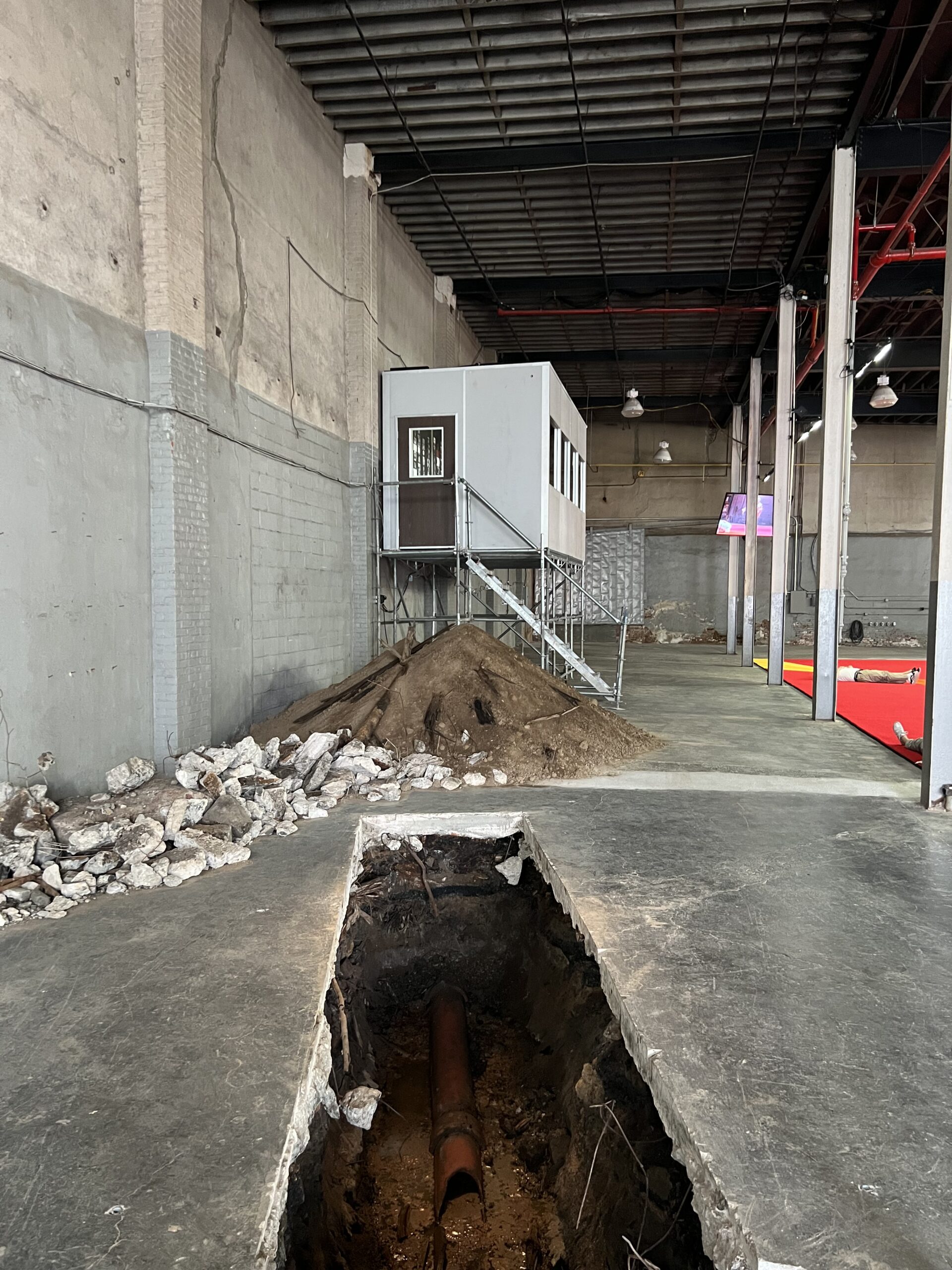
Amid the vast gray setting of steel, concrete, and support columns is a large, strikingly colorful field of artificial turf, in the center of which is the Field Emblem, an idée fixe from throughout Barney’s oeuvre that in the past he has specifically related to football. Hanging above the field is a three-sided jumbotron, similar to that which one would see at a professional sporting event. Additional screens are also placed near each of the field’s corners, much like the screens placed throughout an arena or stadium. Floodlights are mounted to establish the field as the central focal point. To one side is a makeshift press box of sorts and to the other is a row of benches. Viewers are welcome to watch the screens from the field, the benches, or to walk around and change perspective throughout the 60-minute duration (the length of a football game, without breaks or stoppages).
The film plays across five screens simultaneously: the jumbotron shows the same feed on each of its three sides, and the other four screens vary throughout—sometimes showing different perspectives of the same scene, sometimes showing different scenes entirely, and other times synchronizing either in pairs or across four or all five screens. Hence the film promoting repeated viewings. I was present for multiple screenings and saw several new things each time. Additionally, each screen has its own sound feed, adding another layer that phases in and out of sync.
Viewers watch in the arena / exhibition space
Though abstracted, familiar rituals play out. First we see the various participants prepare: athletes train and warm up; the owner facilitates the site; fans excitedly await the game; referees consult one another; everyone gets in place (the teams and referees take the field; the owner goes to the press box; fans gather around); the national anthem is given focused attention; the game is played; the fans leave; the site resets for the next contest. The assorted preparations constitute a majority of the film, but they gradually build narrative tension, as the viewer knows that the game and injury will eventually occur, but not when or how. Also, it’s not unlike a real athletic regimen: most of the time is spent in preparation and maintenance—training, running drills, practicing maneuvers—and is punctuated by the occasional game (or race or event, etc.), particularly in professional American football which follows a roughly weekly game schedule during its regular season.
Throughout approximately the first half of the film, bodies work solo, in concert with one another, and in dialogue with materials. Various actions, from routine movements such as throwing a ball and assorted calisthenics to repetitive head trauma, are deconstructed by performers David Thomson, Shamar Watt, Raphael Xavier, Wally Cardona, Ted Johnson, and Matthew Barney. Similarly, numerous materials are physically engaged: tubing, garbage bins, polycaprolactone (PCL), clay, a muddy trench. Just as a game showcases, at least in part, much of the preparation that has gone into it, the game in Secondary—including the national anthem as the opening act— is where all of the pieces come together. It features movement (solo and in concert), music (solo and in concert), and materials (in various stages of rigidity). The game is also the first time we see all performers (athletes, officials, fans, etc.) in the same space and interacting to some degree as a group. Tension is heightened by finally bringing the two teams into direct confrontation, as they’ve been presented as training separately up until this point (though all within the studio and sometimes near one another).
One noteworthy fact about the the six performers who portray the athletes is that most of them don’t have backgrounds playing football. (Barney, who played football while at Yale, has woven athleticism generally and football specifIcally through much of his output.) I highlight this because Barney generally prefers practitioners over actors—in this case, one would assume a football player. That said, by selecting movement artists, the performers were able to home in on specific movements and actions divorced from the context of a specific game or sport. A film ostensibly about football, at least in one regard, does not show a literal sequence one would see in an actual game of football, yet it powerfully conveys a message about such all the same. (I’m reminded of Wagner’s Die Meistersinger von Nürnberg, an opera about a song contest yet lacking a single unbroken aria.) However because the game is so ubiquitous in America, most people have at least a passive familiarity with the sport, its presentation, and its actions. Secondary does include one actor: Thomas Kopache as Raiders owner Al Davis. His expressive gaze haunts the film, particularly during the national anthem.
Because the subject is so familiar, it can be approached indirectly and still be legible to a wider audience. Consequently, Secondary is the most accessible of Barney’s major works, at least in recent years. While not mainstream by any means, the subject matter, length, and overall presentation (playing in a loop in an open gallery) are likely to be more welcoming than scheduled screenings of feature-length (or longer) works about the cosmic hunt or bespoke Egyptian mythology or the like. While it does lack explicit imagery, a foreboding sense of violence—immediate, psychological, cultural—permeates much of the running time.
Composer Jonathan Bepler shapes a compelling sonic experience. Like Redoubt, the music and sound here are more complementary and decorative as opposed to a shared centerpiece, as with the operatic River of Fundament. However, a noteworthy change in Secondary is that, I believe, a vast majority of the music and sound has a diegetic source. (It may be occasionally treated after the fact, but “external” sounds are rare.) While there may be seemingly non-diegetic instances—e.g., hearing sounds from one screen while looking at another, or seeing vocalizations begin with one character while the camera cuts to another character—there is little-to-no semblance of an external score. As with the film and the site, the music is contained within the film’s universe itself. Save some percussive elements made corporeally or with found objects, much of the rest of the score is vocal, particularly in the vein of the free vocalizations found in River of Fundament and Redoubt. Several of the recurring vocal techniques mimic those found at a sporting event. Examples include: – Vocalizations to mimic the sound of a referee’s whistle, occasionally made by the performers portraying referees – Screaming and rasping reminiscent of a crowd’s cheers, often made by those portraying fans – Quick staccato utterances of “hut” and other syllables, often done by the referees when consulting one another – Groans and croaks redolent of an injured player
A pivotal scene dramatizes Barney’s dissection of the national anthem ritual. After the players and referees take the field, the owner ascends to the press box, and the fans gather around, soprano Jacquelyn Deshchidn, a Chiricahua Apache, adorned in gold and wearing wings, takes center stage (on or near the Field Emblem). Instead of singing “The Star-Spangled Banner,” Deshchidn performs an aggressive and mournful improvisatory piece lasting several minutes. Deceptively, their piece begins on “O,” but the similarities quickly end. Here Deshchidn is accompanied by the chorus of referees portrayed by Isabel Crespo Pardo, Jeffrey Gavett, and Kyoko Kitamura. Notably, this passage includes the only instance (lasting a couple of seconds at most) of consonant harmony throughout the whole film, occurring at approximately the 46-minute mark, and its rarity and unexpectedness yields a great impact. Deschchidn’s anthem also includes the lone clear word uttered in all of Secondary, “bombs,” which is repeated in quick succession at varying intervals and dynamics by both soloist and chorus. Throughout much of their performance, Deshchidn locks eyes with Kopache’s Al Davis as he glares down from the press box.
Deschidn during the anthem (Jerry Saltz watches, sans coffee)
It should be noted that this is the third successive major work that situates an Indigenous American character in a central role: Jacquelyn Deshchidn’s national anthem in Secondary, Sandra Lamouche’s hoop dance in Redoubt, and, among others, Chief David Beautiful Bald Eagle as Norman III (i.e., the version of Norman closest to being divine) as well as pow wow ensemble Mystic River in River of Fundament. Though representing different tribes and traditions, it’s no coincidence that Barney has centered the generally shared Indigenous American experience when exploring violence, mythology, nature, and industrialization in American contexts.
Signature Barney elements appear throughout the film. Plastics and metals are engaged in various states: viscous PCL handled by Watt and Cardona; dumbbells molded from clay and plastic; a triptych of sculptures resulting from the impacts between Thomas and Xavier recreating the Stingley-Tatum trauma. There are also references and allusions to earlier work. In one sequence, a pair of athletes engage a large salt block, such as those seen in River of Fundament. The trench itself, as well as Watt’s physical dialogue with the mud and the filth also have obvious parallels to River of Fundament. In addition to further exploring the boundaries of dance and movement highlighted in Redoubt, a sculpture from the same film is seen in the studio during an early sequence of Secondary. Of course, the concept of creating via movement and resistance is at the heart of Barney’s long-running Drawing Restraint series. The Field Emblem has permeated Barney’s work for decades, including being highlighted in Cremaster Cycle and Drawing Restraint 9, among others. And football has been a recurring subject and influence in his work going back to some of his earliest output such as Facility of DECLINE.
The current exhibition includes more than just the film. The site itself is, as Barney notes, a “central character” in Secondary, so one may move around the studio, including onto the field (and sit or lay if preferred). The trench remains and may be viewed up close. The press box, though closed off, still stands. Within it are a storyboard and a sculpture, possibly a water casting. A work on canvas, a take on the field of play featuring the Field Emblem, hangs on one wall of the studio. Bringing the show full circle, an Otto jersey is also displayed.
Trench, press box
I highly recommend Secondary if you have the opportunity. Although it may possibly screen elsewhere in future months or years, seeing the film where it was created—in the space adapted for that purpose—is a singular experience, one I’ll always treasure.