Category Archives: Performance

Roscoe Mitchell’s “Nonaah” Live in Seattle 06.07.13

For readers old and new, I’d like to plug what promises to be an iconic concert of avant-garde music coming up in Seattle, WA. Table & Chairs, an experimental music label based in Seattle, will be presenting a concert dedicated to free saxophonist and experimental icon Roscoe Mitchell. Specifically, the concert will feature various incarnations and interpretations of Roscoe Mitchell’s “Nonaah”: for solo saxophone (by Mitchell himself!), a new arrangement performed by Lawson, and a new piece based on “Nonaah” by Bad Luck, among others. Mitchell will also present a pre-concert talk and Q&A.

(The folks over at Table & Chairs reached out and asked if I’d help them promote the concert, and I’m happy to do so. It promises to be a memorable evening of sound.)

Roscoe:
If Roscoe Mitchell is new to you, he’s been mentioned on the blog in relation to Evan Parker here and here. In brief, he’s been at the vanguard of improvised saxophone music since the 1960s. I hesitate to simply say “jazz,” as that can be a loaded term – his music often transcends traditional notions of jazz improvisation, even free jazz. (Similar to my thinking of Evan Parker as a “free saxophonist” instead of a “free jazz saxophonist.”) He was an integral figure of the Association for the Advancement of Creative Musicians (AACM), the Art Ensemble of Chicago, and the Creative Arts Collective (CAC). (Interestingly enough, the CAC was founded in East Lansing, MI, the home of yours truly. What’s more is, jazz-wise, the city is now under the near monopoly of Wynton Marsalis sidemen and disciples… That never fails to fascinate me.)

Mitchell is better experienced than read about. Here are a couple of live clips:
w. the Art Ensemble of Chicago in 1991 — “Onhedaruth” (he’s the first to solo right out of the gate, and his soprano textures at 9:00 are something to behold)

Solo at the Konfrontationen Nickelsdorf 2010 (I particularly like his polyphonic approach at ~7:00…)

The Concert:
If you’ll be in the Northwest and are at all interested in improvised, new, or experimental music, I highly encourage you to attend this one-time performance. If you happen to know of anyone in that area, please pass along this post or direct them to Nonaah.com. Info:

Official Website: Nonaah.com
Date: Friday, June 7, 2013
Pre-concert talk: 7:15 PM
Performance: 8:00 PM
Price: $30 GA ($20 for students)
Location: Benaroya Hall; Seattle, WA
Program Info
Presented by Table & Chairs

Earnestness or Excuses? II

I’d like to continue exploring the topic of intention and reception. I ended my previous post on this topic referencing technical ability and execution. This was on my mind quite a bit a few weeks ago as I listened to Pat Metheny and Ornette Coleman‘s Song X: Twentieth Anniversary. I really enjoy that album, as I enjoy both Pat and Ornette separately, but I found myself still tuning out through Ornette Coleman’s violin solo in “Mob Job.” For the uninitiated, Coleman famously – infamously? – extended his free jazz (or harmolodic) approach beyond the saxophone, his instrument, and started incorporating trumpet and violin – instruments he couldn’t play. After years of this, he’s now labeled as a saxophonist, trumpeter, and violinist in many articles.

I could listen to Ornette’s sax playing all day long and really dig it, but there’s a part of me that can’t get past his taking up instruments and just making noise without any ability. While most lay listeners would probably just think it all sounds the same, I can’t get past it as a musician. (And no, it certainly does not sound the same.) For reference, here’s some footage of Coleman on violin, later switching to trumpet (it’s entertaining to see him adjust the violin’s fine tuning peg):

Now contrast that with his saxophone playing from the same concert (the first half of this video). I get behind this. It’s not just a sonic wash of ascending and descending passages:

Before going further, I should say that I don’t mean for this article to be an “attack” on Coleman. Far from it. (And what would he care, he’s accomplished far more in his career than I could hope to.) I do genuinely enjoy his music and greatly appreciate what he did for art. But this one aspect sticks in my craw and, more importantly, relates to the larger topic I started exploring here a few weeks back. In fact, many more offensive examples that I’ve seen in person come to mind, but Coleman’s perhaps the most well-known example I can think of for use here. I find myself really agreeing with Miles Davis on this point (from his autobiography):

For him – a sax player – to pick up a trumpet and violin like that and just think he can play them with no kind of training is disrespectful toward all those people who play them well. And then to sit up and pontificate about them when he doesn’t know what he’s talking about is not cool, man. But you know, music’s all just sounds anyway.[1. Miles Davis with Quincy Troupe, Miles: The Autobiography, (New York: Simon & Schuster, 1989), p. 250.]

I sympathize with both Miles’s disagreement but also his acknowledging the place of sound. If someone just wants a wash of ascending and descending lines, then who cares if they play the instrument well or not? I easily concede that point, as I get it from an artistic/theoretical perspective. What if a musicians just wants a bunch of squeaks and squawks on the saxophone? One could argue that it may be best for a non-saxophonist to produce such sounds. In fact, we can see this here in a live video of none other than Marilyn Manson in 2005:

Before too many of you raise your eyebrows and say that Mary (as I’ve called him since middle school) is just being obnoxious while Ornette is creating art, briefly consider a few things:
1. Yes, the saxophone was used to create noise. That was the intent.
2. This occurs at the end of the title song of 2003’s The Golden Age of Grotesque. That whole album (and tour and surrounding ethos) was not just about “the grotesque,” which is vague, but rather it drew heavily from German Kabarett, censorship (particularly the Degenerate Art exhibitions under the Third Reich), and minstrelsy. He then connected those themes with post-Columbine and post-9/11 American culture. (Manson’s no intellectual slouch…)[2. If you want to go deeper down this rabbit hole, I suggest this article that I recently came across when assembling some links for this post. Good stuff.]
3. Strictly focusing on saxophone, kudos to him for using a period-appropriate model. Sigurd Rascher would’ve been proud. 🙂
4. Outside of including “saxophone” under his name in the album’s liner notes, Mary isn’t referred to as a “saxophonist” in his articles or titles. He understands the context.
5. FYI: I didn’t go searching for an outrageous example saxophone squawks to be incendiary. The last time I saw Marilyn Manson in concert was on this tour in 2003, and I occasionally go back to that memory when thinking of this particular instrumental conundrum.

Context matters, of course. Because at the end of the day they’re two men making noise on instruments they can’t play.

Now of course there can be an intersection between the above two poles in which someone “makes noise” on his/her primary instrument that seems indiscernible from a novice. Some of Evan Parker‘s music comes to mind. In the below video, if you were to just watch the images without sound, one would think he’s just letting his fingers run wild. However, when you actually listen to his sounds, you hear incredible control of both tonguing, range, and contour. He manages polyphony all by himself. (I can be partial, though, because I’m a Parker fan.):

Also, Parker’s no one-trick pony. His playing on Boustrophedon and Composition/Improvisation No. 1, 2, & 3 is different, for example. As is his playing in the second video of this MTH-V post.

Whew. Well, that’s enough to chew on for now. I’ll definitely be returning to this topic. And, as I said in my last post in this series, these are real rough drafts. I’m just trying to collect my thoughts on this topic.


Earnestness or Excuses?

Lately I’ve been thinking quite a bit about artistic intention and reception. It’s been difficult to get all of my duck-like ideas in a row, and I’ll in no way fully address the issue with one post, but it’s worth planting the seed.

I’ve quietly been focused on this the last couple months, but it really came to the fore when Matt Borghi and I touched on it in conversation during one of our recent lunches (where we wax philosophically about music, comedy, politics, the internet, our neighborhoods, and all things in between). Improvisation is perhaps the cornerstone of our musical relationship, and on this particular day we got to talking about improvisation itself. He mentioned an interesting dialogue he’d recently had with another musician, and – I’m paraphrasing so I could be a little off – that, generally, music that is largely improvised suggests at least a small degree of laziness on the part of the performer(s). In some cases this is true. However, to use that as an overall guiding principle shocked me. Especially since it came from another musician in a somewhat related realm.

As one example, my ambient-based work with Matt, we improvise not out of lack of forethought but because we’re feeding off of one another in the moment. What we each bring to the table continually changes. Yes, we have “rehearsed” many times, but we’re not rehearsing content. Instead we’re rehearsing our engaging one another musically. We’re continually learning and refining how we listen and respond to one another. Conversely, while there’s much room for improvising in our Teag & PK catalogue, we rehearse and adhere to our musical forms and roadmaps, as those songs are based on set content.

[Shameless plug: please check out Convocation if you haven’t yet. We’re quite proud of it. 🙂 ]

In both aforementioned settings – ambient and folkish – the performer’s respect for the content (and how that content is created) is a key factor. Another important element is a respect for the craft of being able to make the music. This could the technical facility/mastery of an instrument and/or the craft of songwriting or improvising. So not only am I concerned with the style of music I’m performing, but how well I may execute it on a given instrument. How can I properly express myself through an instrument I can’t play? Furthermore, how can I express myself on an instrument I can play but through a style I cannot?

Much more to come on this as I start to flesh out some related thoughts…

March Dates

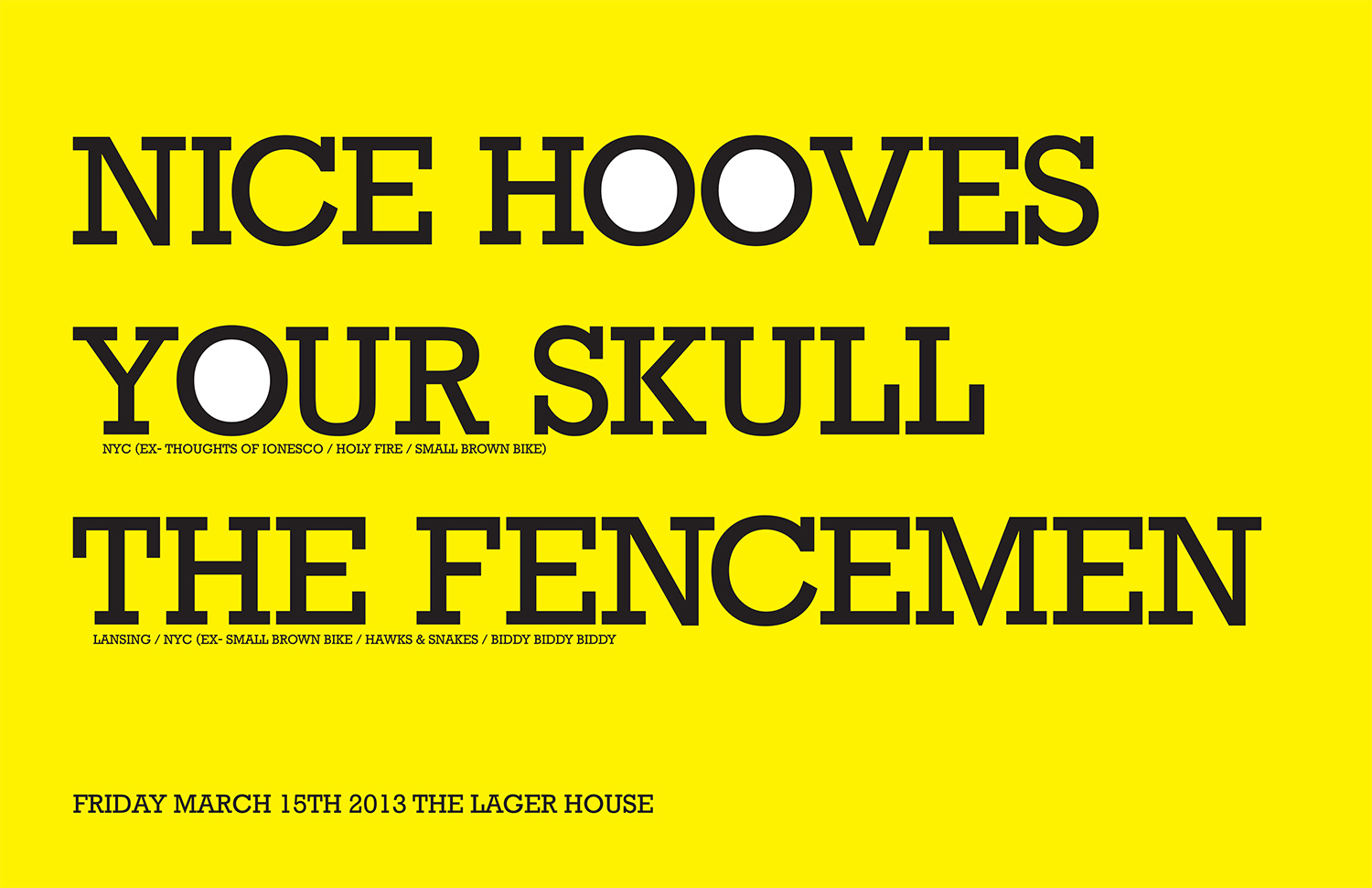
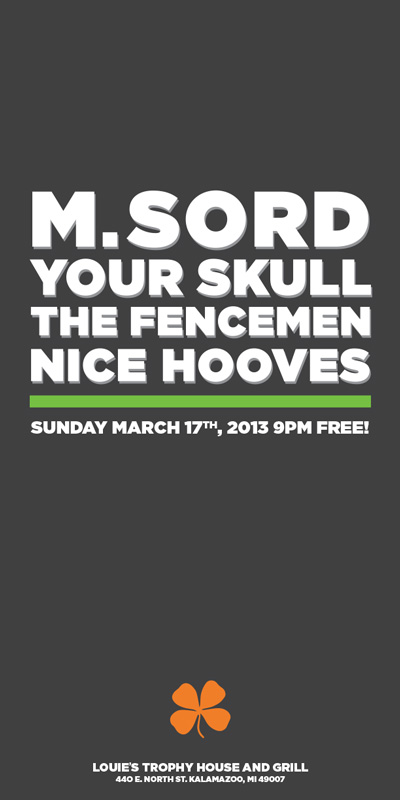
I rarely advertise gigs on the blog but I have a few coming up that I think are worth mentioning. The Fencemen are embarking on a mini-tour this coming weekend with Brooklyn’s Your Skull. I don’t know where all of you readers are located, but I do know that I get steady traffic in southeast MI (particularly Ann Arbor and Detroit) as well as Chicago. We’ll be near you both, along with Kalamazoo:
• 03.15.13 – Detroit, MI
• 03.16.13 – Chicago, IL
• 03.17.13 – Kalamazoo, MI

Full info below. Also, the following weekend, I’ll be in Muskegon playing in the Fame pit (check my itinerary if interested in that). But for St. Patrick’s Day weekend, if you’re around, come get a loud and lovely dose rock and roll. Bring your ear plugs, sturdy shoes, and good vibes. The Fencemen, Your Skull, and all of the other bands plan to tear it up…

—-

[Re-posted from michaelteager.com:]

The Fencemen are hitting the road next weekend for a brief mini-tour of Detroit, Chicago, and Kalamazoo with Brooklyn’s Your Skull. All the shows promise to be fun and raucous – rock with a capital R-A-W-K. Info and links are available at my Itinerary page as well as both bands’ sites and pages. Definitely check us out if you can!

03.15.13 — Detroit, MI — PJ’s Lager House
NiceHooves-Your-Skull-Mar15th-Web


03.16.13 — Chicago, IL — FML


03.17.13 — Kalamazoo, MI — Louie’s Trophy House & Grill
msord_st_patty

‘Convocation’ Out Now

Convocation, the new album by Matt Borghi and myself, is now available. I mentioned it a couple posts back when previewing 2013. The album was officially released digitally on January 31, but we’ve been waiting to really advertise it until we approved and finalized the hard copies.

My collaboration with Matt is five years old this year, and it’s been an ongoing reference on this blog. From our time together in The Elevator Conspiracy to our duo work in a variety of genres under both our own names and Teag & PK, we’ve been fighting the good fight – at least if you ask us for our opinion – for a few years now. A couple of last year’s posts were specifically about us. (See here and here.) Long story short, we cover a lot of musical ground. We started out with lounge-ish and jam-ish rock in The Elevator Conspiracy. Then, as a duo, we first explored acoustic indie-rock territory, but quickly pursued a parallel path of ambient-centric improvisation. We’ve continued down both paths the last couple years, but rarely have we mixed them. As Teag & PK, we perform original songs in coffee houses and on the radio. As Matt Borghi & Michael Teager, we explore sound in art galleries and other “listening space” environments. Convocation is an accidental culmination of the latter, and our first full-length album of either style.

I say accidental because we never intended for this to be an album. At least not originally. After a ~6-8 month spurt with our singer/songwriter material last year, we decided to go ambient at the last minute before a gig. (Matt wrote a great article about that evening here.) That gig’s success reinvigorated our ambient leanings, and so we booked some studio time a couple weeks later at Dan Jaquint‘s The Fort. We entered the studio with no plan other than wanting to capture some our new-found spirit. At best, we hoped to walk away with ~15 minutes of usable material for use as a launching point for an eventual album or project down the road. Because of our low expectations, our “rehearsing” consisted of a couple lunches, phone calls, and emails. Matt sent me about six minutes worth of sketches that he had been messing with, but we hadn’t played together since the aforementioned gig. Horn in hand, I noodled with those sketches for about ten minutes. That was it.

Once we were all set to go in the studio, we told Dan that we just wanted to record some chunks of improvisations. With our levels, etc., set, all he really needed to do was start and stop the recording equipment. For the first attempt, we improvised over a recently-composed loop of Matt’s for about 15-20 minutes. Once finished, we looked at each other with much relief – this was going much better than expected. So over the next ninety minutes we laid down four more chunks: two fully improvised without pre-conceived loops, and two fully improvised over loops that Matt had put together since our last gig. We had surprised ourselves and ended up with possibly more than our hoped-for 15-20 minutes of material.

All five of that evening’s sonic treks make up Convocation. Presented in the order in which they were recorded, all of the source material was recorded live. I say “source material” because Matt did some post-production work with the mix and other audiophile-related items, but, except for cutting out some chunks for brevity’s sake, the musical content wasn’t copied-and-pasted together a la Bitches Brew. Over the next several months we contemplated what to do with the material, finally deciding to release it via Matt’s record label Slo.Blor Media – an excellent source for ambient music and sound art.)

For purists, this album arguably may not be a strictly “ambient” work. While the whole album is grounded in an ambient foundation, the focal point, if there is one, is the improvisational monologues and dialogues. That’s where one may possibly hear jazz-ish influences, though don’t waste your time listening for any bop licks. Each of the five tracks is a collective improvisation over soundscapes, two of which were fully improvised and continually change. No “melodies,” “hooks,” or “beats.” Just sound. It’s somewhere in the nexus of ambient, jazz, sound art, and contemporary classical. (The latter if it were notated, but it wasn’t so it’s not.) Again, neither Matt nor I care what you call it. We haven’t even settled on the nomenclature. This is something we’re very proud of and want to share with open, willing ears. What you call it is a distant second to how you receive it.

Please do check it out if you’re interested. Feel free to drop a line if you dig it. And if you feel so inclined, feel free to leave a review on iTunes or Amazon.

Convocation is now available via iTunes, Amazon, eMusic, and Spotify. And you may order a hard copy via Kunaki. For more info, you can visit:
http://slobormedia.org
http://www.mattborghi.com
http://michaelteager.com

Here’s the official press release from Slo.Bor Media:

Convocation is the work of ambient composer Matt Borghi (www.mattborghi.com) and saxophonist Michael Teager (www.michaelteager.com). Recorded as a series of improvisational structures in spring of 2012, this is the first recording that Borghi and Teager have done together after a half-decade of working together.

With Convocation, Borghi brings in spacious guitar textures to create a harmonic fabric for Teager to lay out his saxophone playing with subtlety and nuance. With a background in classical and jazz saxophone, Teager brings a wide palette of influences to the music. Listeners will hear aspects of Jan Garbarek, John Coltrane and Dave Liebman that’s juxtaposed over Borghi’s pastoral guitar sounds that have more of their timbral origins in the work of Claude Debussy or Ralph Vaughan-Williams than they do other contemporary ambient guitarists.

Convocation, as a whole, aims to create a deep and timbrally interesting listening experience while also bringing together an interesting musical pairing and improvisational process. Saxophone and ambient music have never sounded like this, and Borghi & Teager attribute this to their friendship, their approach to the work and their diverse musical interests.

Buy the hard copy CD here now, or you can visit online retailers such as Amazon, iTunes, or eMusic to name just a few…