Category Archives: Performance

Earnestness or Excuses?

Lately I’ve been thinking quite a bit about artistic intention and reception. It’s been difficult to get all of my duck-like ideas in a row, and I’ll in no way fully address the issue with one post, but it’s worth planting the seed.

I’ve quietly been focused on this the last couple months, but it really came to the fore when Matt Borghi and I touched on it in conversation during one of our recent lunches (where we wax philosophically about music, comedy, politics, the internet, our neighborhoods, and all things in between). Improvisation is perhaps the cornerstone of our musical relationship, and on this particular day we got to talking about improvisation itself. He mentioned an interesting dialogue he’d recently had with another musician, and – I’m paraphrasing so I could be a little off – that, generally, music that is largely improvised suggests at least a small degree of laziness on the part of the performer(s). In some cases this is true. However, to use that as an overall guiding principle shocked me. Especially since it came from another musician in a somewhat related realm.

As one example, my ambient-based work with Matt, we improvise not out of lack of forethought but because we’re feeding off of one another in the moment. What we each bring to the table continually changes. Yes, we have “rehearsed” many times, but we’re not rehearsing content. Instead we’re rehearsing our engaging one another musically. We’re continually learning and refining how we listen and respond to one another. Conversely, while there’s much room for improvising in our Teag & PK catalogue, we rehearse and adhere to our musical forms and roadmaps, as those songs are based on set content.

[Shameless plug: please check out Convocation if you haven’t yet. We’re quite proud of it. 🙂 ]

In both aforementioned settings – ambient and folkish – the performer’s respect for the content (and how that content is created) is a key factor. Another important element is a respect for the craft of being able to make the music. This could the technical facility/mastery of an instrument and/or the craft of songwriting or improvising. So not only am I concerned with the style of music I’m performing, but how well I may execute it on a given instrument. How can I properly express myself through an instrument I can’t play? Furthermore, how can I express myself on an instrument I can play but through a style I cannot?

Much more to come on this as I start to flesh out some related thoughts…

March Dates

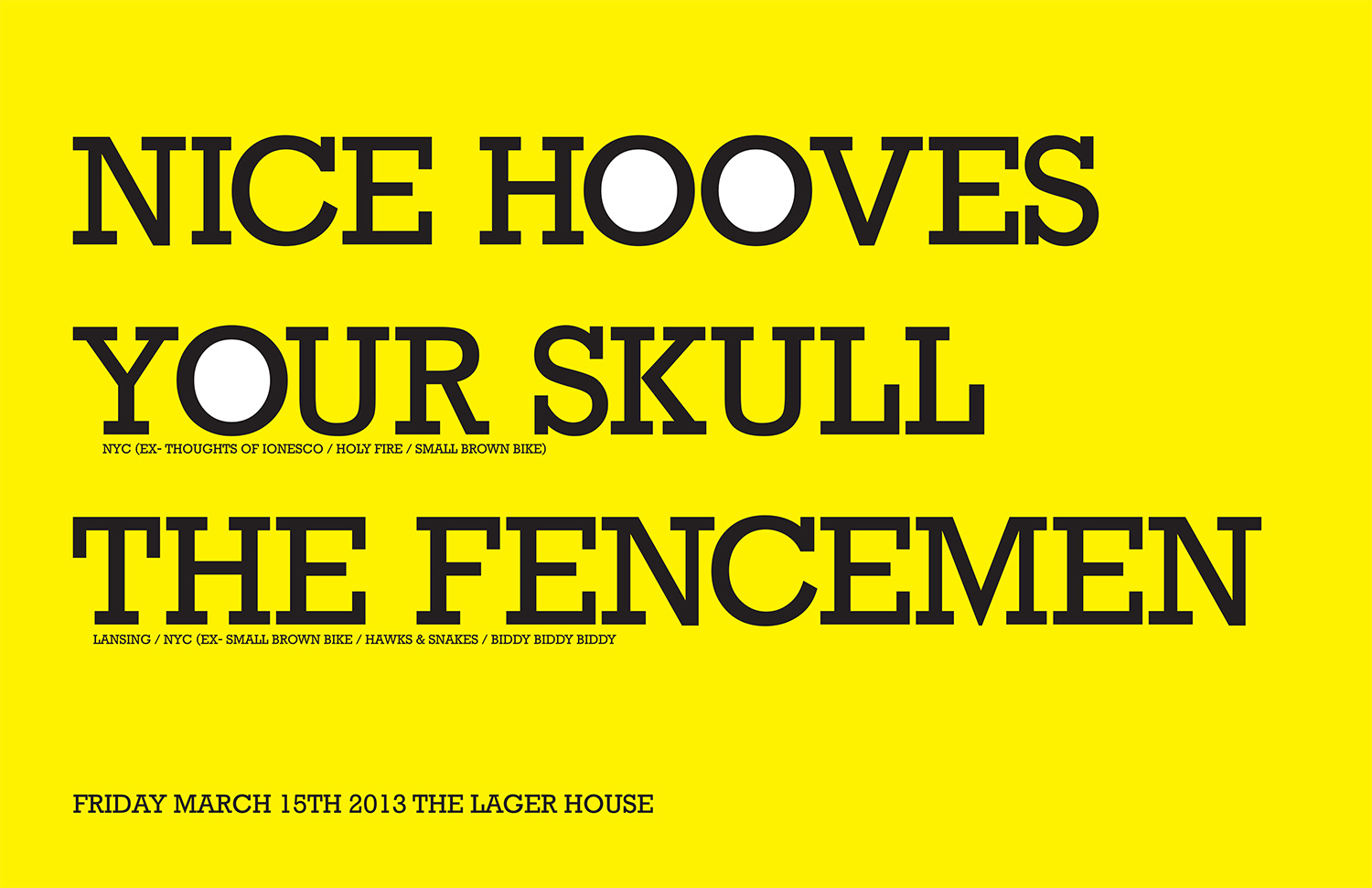
I rarely advertise gigs on the blog but I have a few coming up that I think are worth mentioning. The Fencemen are embarking on a mini-tour this coming weekend with Brooklyn’s Your Skull. I don’t know where all of you readers are located, but I do know that I get steady traffic in southeast MI (particularly Ann Arbor and Detroit) as well as Chicago. We’ll be near you both, along with Kalamazoo:
• 03.15.13 – Detroit, MI
• 03.16.13 – Chicago, IL
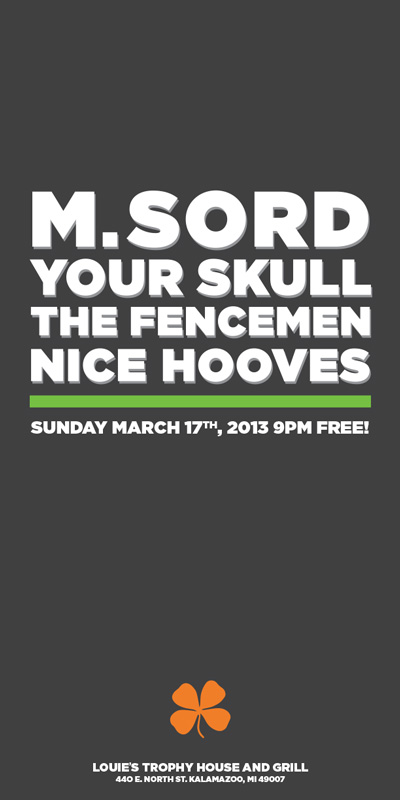
• 03.17.13 – Kalamazoo, MI

Full info below. Also, the following weekend, I’ll be in Muskegon playing in the Fame pit (check my itinerary if interested in that). But for St. Patrick’s Day weekend, if you’re around, come get a loud and lovely dose rock and roll. Bring your ear plugs, sturdy shoes, and good vibes. The Fencemen, Your Skull, and all of the other bands plan to tear it up…

—-

[Re-posted from michaelteager.com:]

The Fencemen are hitting the road next weekend for a brief mini-tour of Detroit, Chicago, and Kalamazoo with Brooklyn’s Your Skull. All the shows promise to be fun and raucous – rock with a capital R-A-W-K. Info and links are available at my Itinerary page as well as both bands’ sites and pages. Definitely check us out if you can!

03.15.13 — Detroit, MI — PJ’s Lager House
NiceHooves-Your-Skull-Mar15th-Web


03.16.13 — Chicago, IL — FML


03.17.13 — Kalamazoo, MI — Louie’s Trophy House & Grill
msord_st_patty

‘Convocation’ Out Now

Convocation, the new album by Matt Borghi and myself, is now available. I mentioned it a couple posts back when previewing 2013. The album was officially released digitally on January 31, but we’ve been waiting to really advertise it until we approved and finalized the hard copies.

My collaboration with Matt is five years old this year, and it’s been an ongoing reference on this blog. From our time together in The Elevator Conspiracy to our duo work in a variety of genres under both our own names and Teag & PK, we’ve been fighting the good fight – at least if you ask us for our opinion – for a few years now. A couple of last year’s posts were specifically about us. (See here and here.) Long story short, we cover a lot of musical ground. We started out with lounge-ish and jam-ish rock in The Elevator Conspiracy. Then, as a duo, we first explored acoustic indie-rock territory, but quickly pursued a parallel path of ambient-centric improvisation. We’ve continued down both paths the last couple years, but rarely have we mixed them. As Teag & PK, we perform original songs in coffee houses and on the radio. As Matt Borghi & Michael Teager, we explore sound in art galleries and other “listening space” environments. Convocation is an accidental culmination of the latter, and our first full-length album of either style.

I say accidental because we never intended for this to be an album. At least not originally. After a ~6-8 month spurt with our singer/songwriter material last year, we decided to go ambient at the last minute before a gig. (Matt wrote a great article about that evening here.) That gig’s success reinvigorated our ambient leanings, and so we booked some studio time a couple weeks later at Dan Jaquint‘s The Fort. We entered the studio with no plan other than wanting to capture some our new-found spirit. At best, we hoped to walk away with ~15 minutes of usable material for use as a launching point for an eventual album or project down the road. Because of our low expectations, our “rehearsing” consisted of a couple lunches, phone calls, and emails. Matt sent me about six minutes worth of sketches that he had been messing with, but we hadn’t played together since the aforementioned gig. Horn in hand, I noodled with those sketches for about ten minutes. That was it.

Once we were all set to go in the studio, we told Dan that we just wanted to record some chunks of improvisations. With our levels, etc., set, all he really needed to do was start and stop the recording equipment. For the first attempt, we improvised over a recently-composed loop of Matt’s for about 15-20 minutes. Once finished, we looked at each other with much relief – this was going much better than expected. So over the next ninety minutes we laid down four more chunks: two fully improvised without pre-conceived loops, and two fully improvised over loops that Matt had put together since our last gig. We had surprised ourselves and ended up with possibly more than our hoped-for 15-20 minutes of material.

All five of that evening’s sonic treks make up Convocation. Presented in the order in which they were recorded, all of the source material was recorded live. I say “source material” because Matt did some post-production work with the mix and other audiophile-related items, but, except for cutting out some chunks for brevity’s sake, the musical content wasn’t copied-and-pasted together a la Bitches Brew. Over the next several months we contemplated what to do with the material, finally deciding to release it via Matt’s record label Slo.Blor Media – an excellent source for ambient music and sound art.)

For purists, this album arguably may not be a strictly “ambient” work. While the whole album is grounded in an ambient foundation, the focal point, if there is one, is the improvisational monologues and dialogues. That’s where one may possibly hear jazz-ish influences, though don’t waste your time listening for any bop licks. Each of the five tracks is a collective improvisation over soundscapes, two of which were fully improvised and continually change. No “melodies,” “hooks,” or “beats.” Just sound. It’s somewhere in the nexus of ambient, jazz, sound art, and contemporary classical. (The latter if it were notated, but it wasn’t so it’s not.) Again, neither Matt nor I care what you call it. We haven’t even settled on the nomenclature. This is something we’re very proud of and want to share with open, willing ears. What you call it is a distant second to how you receive it.

Please do check it out if you’re interested. Feel free to drop a line if you dig it. And if you feel so inclined, feel free to leave a review on iTunes or Amazon.

Convocation is now available via iTunes, Amazon, eMusic, and Spotify. And you may order a hard copy via Kunaki. For more info, you can visit:
http://slobormedia.org
http://www.mattborghi.com
http://michaelteager.com

Here’s the official press release from Slo.Bor Media:

Convocation is the work of ambient composer Matt Borghi (www.mattborghi.com) and saxophonist Michael Teager (www.michaelteager.com). Recorded as a series of improvisational structures in spring of 2012, this is the first recording that Borghi and Teager have done together after a half-decade of working together.

With Convocation, Borghi brings in spacious guitar textures to create a harmonic fabric for Teager to lay out his saxophone playing with subtlety and nuance. With a background in classical and jazz saxophone, Teager brings a wide palette of influences to the music. Listeners will hear aspects of Jan Garbarek, John Coltrane and Dave Liebman that’s juxtaposed over Borghi’s pastoral guitar sounds that have more of their timbral origins in the work of Claude Debussy or Ralph Vaughan-Williams than they do other contemporary ambient guitarists.

Convocation, as a whole, aims to create a deep and timbrally interesting listening experience while also bringing together an interesting musical pairing and improvisational process. Saxophone and ambient music have never sounded like this, and Borghi & Teager attribute this to their friendship, their approach to the work and their diverse musical interests.

Buy the hard copy CD here now, or you can visit online retailers such as Amazon, iTunes, or eMusic to name just a few…

2012 Recap & 2013 Preview

*Dusts cobwebs off*

…and the blog returns. It’s been a quiet couple months for this site, mainly because the last part of 2012 was pretty intense away from the computer. Teaching, gigging, working, etc., aside, my wife and I bought and moved into our first house. (Hence the last MTH-V post.) While it obviously wasn’t unexpected, it was much sooner than we had anticipated. At any rate, 2013 is now in full swing. But more importantly, the battery has been recharged and most unpacking is complete. I know there are some readers out there – this isn’t completely in a vacuum – so expect regular posts to resume.

2012 was a great year musically and personally. (Since this is a music-centric blog, and not a personal one or otherwise, I’ll stick to musical highlights.) Looking back:

Playing: I played a wide variety of gigs throughout the year, as usual, but a few projects are worth special mention.
• Ongoing collaboration with Matt Borghi — Matt and I continued our somewhat schizophrenic musical quest. I don’t say that as a pejorative, but with pride. We have too many interests to stick to just one bag of tricks. (Longer discussions here and here.) We played a number of shows and also released a single under our acoustic rock moniker Teag & PK. And we also continued our ambient explorations. The latter yielded a full album, Convocation, that is to be released in the coming weeks. More details quite soon as the official release nears. We’re very excited about it.
The Fencemen — I met and started playing with The Fencemen last year. I contributed some sounds to “Rented Rooms” (on Times Are Alright – my review here) and have been playing live with them since April. Gritty rock and roll…check it out.
• White Gold Scorpio — I laid down some tracks for Halloween Island (specifically “Throw Myself At You” and “Scare You Like I Do”). This was purely studio work, as the group is based in Brooklyn. It’s a real good album and I’m glad to be a part of it.
• I bought a piccolo. 🙂 (For pit work for Annie.)

Concerts: Regular readers (and those who know me personally) know that I attend a lot of performances. Every year I see shows that especially stand out. Here are a few, a number of them being firsts:
• Einstein on the Beach — “Would it get some wind for the sailboat?” Let’s face it: I started 2012 with more than a bang. Being fortunate enough to see this live really was one of those “once in a lifetime” experiences. It’s been just over a year and I still think of it almost everyday. (And occasionally dream about it, but that’s another story…) It had a profound impact on me that I can’t really put into words. (Though I tried to gather my immediate reaction here.) Alex Ross said it best: “ecstatically dumbfounding.” No other 2012 musical experience – and few ever – even compared to this one.
trialeotb
(Photo by Lucie Jansch)
• Charles Lloyd’s New Quartet — I finally saw Mr. Lloyd in Ann Arbor in April. I’ve been a longtime fan of his, so that was a real treat. I can’t think of any other musician whose lines float over the ensemble quite like his. His rendition of “Go Down Moses” still haunts me. Some thoughts here.
• James Carter, Spectrum Road, and Neneh Cherry & The Thing at Montreux Jazz Festival — Although I was initially disappointed that Tricky dropped out, this lineup blew me away in three very different ways. Furthermore, it was great to attend the Montreux Jazz Festival. But even though my show was in Miles Davis Hall, I still wish I could’ve seen the real thing, particularly this 1973 performance.
• Radiohead — Finally. They gave an impeccable performance. I was worried that my years of wanting to see them would raise the bar too high, but shattered my very high expectations. Extended thoughts here.
• Pat Metheny Unity Band and Wayne Shorter Quartet at Detroit Jazz Festival — Technically two first, but not completely. I saw part of Metheny’s Detroit show during his Orchestrion tour (I was playing at the bar downstairs, so I snuck up for a bit), and I saw Wayne Shorter with Herbie Hancock’s quartet in 2004. (The latter show was really something special.) But this was my first Metheny experience with a backing band and I hadn’t yet seen Wayne’s powerhouse quartet with Brian Blade, John Patitucci, and Danilo Perez. Both were stellar. Metheny and Chris Potter were face-meltingly good, whereas Shorter’s quartet successfully opened my third eye for a time. I’m very excited for WSQ’s soon-to-be-released third album.
• Marcus Miller — Another technical first. I saw Marcus Miller as a sideman for Herbie Hancock’s Headhunters 2005 at Bonnaroo, but this was my first time seeing his solo band, which pretty much sticks to the coasts, Europe, and Japan. (That Headhunters 2005 performance was a killer band, and one of the best things I’ve ever seen: Herbie, Marcus, Terri Lyne Carrington, Kenny Garrett, Roy Hargrove, John Mayer [as guitarist, not lead singer], Munyungo Jackson, and Lionel Loueke.) Miller’s solo band didn’t disappoint. It was funky, crunchy, and high-octane from start to finish.
• DMB (various) — Of course. 🙂 Considering there were two separate tours, I was only able to catch four shows in Saratoga, NY, Chicago, and Toronto. (Teaching abroad got in the way of a few others I would’ve seen, and I took 2012 off from The Gorge.) Many of the new songs were really gaining steam by the last time I saw the band. They never disappoint.

Albums: I need to just list them at this point – in no particular order other than the first two – or this post will never end. Again, just some highlights that were released in 2012. (NOTE: These are albums I purchased and listened to…I realize there are some I haven’t gotten around to yet.) But take note: it’s no surprise that my beloved ECM (in bold) is well represented…
Away From The World — Dave Matthews Band
Manu Katché — Manu Katché
Sleeper: Tokyo, April 16, 1979
 — Keith Jarrett & Jan Garbarek
Oceania — Smashing Pumpkins
Live at the Moody Theater — Warren Haynes
Fly — Lettuce
For the Good Times — The Little Willies
The Well — Tord Gustavson Quartet
Spectrum Road — Spectrum Road
The Cherry Thing — Neneh Cherry & The Thing
Unity Band — Pat Metheny
All Our Reasons — Billy Hart
Within A Song — John Abercrombie Quartet
Swept Away — Marc Johnson & Eliane Elias
Gesualdo: Quinto Libro di Madrigali — The Hilliard Ensemble
If Grief Could Wait — Giovanni Pessi & Susanna Wallumrod
Filia Sion — Vox Clamantis

Good thing I didn’t start down the path of albums purchased (but not released) in 2012…


2013 PREVIEW
Looking ahead, there are some musical items worth noting:
• Convocation, my album with dear friend and partner Matt Borghi, will be released in the coming weeks. More on that soon.
• Look for some new music coming from The Fencemen.
• 2013 = 1813+200 = Wagner’s bicentennial. Yes, Richard Wagner – a “complex” figure, to put it lightly. Horrible personal qualities aside, he’s by far my favorite composer. I’m sure he’s been referenced occasionally here. (Don’t let that fool you; the love runs deep.) For instance, one of the only musical experiences comparable to my seeing Einstein on the Beach was when I saw Der Ring des Nibelungen in Chicago in 2005. Expect regular mention of him, his music, and his legacy throughout the year. I’m celebrating by going to see Die Meistersinger von Nürnberg at Chicago Lyric Opera next month, and hopefully another jaunt to Bayreuth while abroad this summer.
rw
Chris Potter will be releasing The Sirens, his first ECM album as a leader. I’m very intrigued to hear what he’s like as a leader under Manfred‘s umbrella. Beyond that, ECM always releases great record, so I’m sure this year will be no exception.
• The blog will resume regular posts over the next couple weeks as this semester’s schedule settles in.


Beyond the Horn

(NOTE: I’m aware that some sweeping generalizations are made here. I intend to deeply sift through this further down the road.)

I play many different styles of music. Regular readers may already know this but, for example, in the last six months I’ve gigged in the following styles: Americana, folk/singer-songwriter, cocktail/wallpaper jazz, “jam band” (for lack of better term – improvisatory rock), sound/ambient, musical theater (Annie), rock. And I’m already in the process of lining up further disparate gigs over the next few months. I’m well aware that I’m not unique for doing so. A number of my colleagues and peers do the same, and there are many musicians in general that do so. However, one supposedly “limiting” factor is that I’m doing all of these gigs on saxophone (tenor, soprano, alto; plus the occasional flute and/or clarinet).

The jazz-, musical theater-, and classical-oriented stuff is no big thing in the sense that there’s already a place for me. In the latter two cases, the music is precisely notated in such a way that there should be no deviation from one performance to the next. In jazz, the history and vocabulary provides a natural context for the horn regardless of who I’m playing with. However, many of the other styles – notably rock, indie, and others of such ilk – aren’t common settings for my instrument. And in those cases where sax is often used, especially in older rhythm and blues and rock and roll styles, it’s performed in such a specific manner that eschewing such conventions – growling, squealing, blues-ing – can be jarring. It’s not that I dislike such affectations – quite the opposite – but over time they created a box that largely remains today.

Over the last four decades, the saxophone has been a sort of cameo rock instrument. (Before then it was often a staple.) When present it is noticeable. It usually seems to be the case that it’s “band + saxophone” as opposed to a band that happens to have a saxophone as a mainstay. There are of course exceptions to this rule – my beloved Dave Matthews Band springs to mind. In the case of DMB, the sax originally substituted the position of lead guitar (trading such responsibilities with violin). Also with DMB, the music has enough jazz-, jam-, or crossover influence to comfortably allow a variety of instruments to fit in. Another band known for marathon concerts, Bruce Springsteen’s E Street Band, of course features sax (the late Clarence Clemons, now his nephew Jake Clemons and Eddie Manion). However, even with The E Street Band, the heavy guitar presence sort of places the sax within the aforementioned box. (Disclaimer: I’m not intimately familiar with Springsteen’s deep cuts, but these are my impressions having explored his catalogue as much as I have.) Just picking one song off the top of my head, “Rosalita” definitely follows in the “rock sax” tradition. Even Pink Floyd‘s use of the saxophone stayed mainly within this vain – e.g., “Money,” “Us and Them,” and “Shine On You Crazy Diamond Pt. 1” (the latter being perhaps my favorite PF song). There’s even a hint of it in Ron Holloway’s playing with The Warren Haynes Band (last week’s MTH-V). Or you could just listen to some George Thorogood. Or Bob Seger. Or…you get the picture…

It’s worth reiterating that I have nothing against the above sax examples or style at large. For the most part, I quite like all of them. But they passively reinforce the stereotypical “rock sax” sound – a near-anachronistic rhythm and blues punch in the face of the 70s, 80s, 90s, or 2000s listener. It’s as if the saxophone stayed in the fifties and sixties while rock continued to evolve alongside it over the next four decades.

Whenever I play with a rock band – sitting in or regularly – I’m compared, consciously or otherwise, to this tradition. (And I mean a real rock/pop band, not just a funk/fusion band that features an electric guitar.) Though I always appreciate it, I can’t help but laugh a little each time I’m told something to the effect of, “I didn’t know what to expect when I saw the saxophone” or “that was really good [or different, in a positive way]!” Because I know that that comparison took place at some point in the performance, even if only for a few milliseconds. And why shouldn’t it? That old R&B – the real R&B: rhythm and blues – sound is deeply embedded in that aural combination of “band + saxophone.”

By no means do I think I’m going where no saxophonist has gone before by avoiding this hangup. To cite a current example, one of the many things I love about Bon Iver‘s sophomore album is Colin Stetson‘s saxophonic contributions. (“MTH-V” on Bon Iver is here.) He plays throughout the material but is rarely at the sonic forefront – his presence is felt as well as heard. And his choice to mostly play the bass saxophone (with some alto and clarinet thrown in for good measure) is definitely unique in a rock setting. He is effective because he adds another noticeable, functional layer without sonically drawing attention to himself. If you were to just sit down and listen to Bon Iver straight through, you wouldn’t necessarily consider it “band + saxophone” (or “band + French horn,” etc.), but rather just a band.

(There are of course other modern/recent examples – Morphine springs to mind.)

When I’m playing with a band – rock, folk, jazz, or anything remotely along those lines – I don’t necessarily think of myself as the saxophonist per se. Instead I’m just another musician in either a lead or supporting role. Or both. Idealistic? Perhaps. But it has an effect on my thinking and consequently my playing. This of course is part of trying to find one’s “authentic voice,” to quote George Carlin. A primary goal for any musician or artist of any kind is to hone one’s craft to the point of developing an original voice/POV. This shouldn’t exist in a vacuum – ideally I should sound like me regardless of style. As I’ve said many times before, I grew up on rock and pop music. The sound is buried in my DNA. If anything I just see myself as another guitarist without getting hung up on the instrument hanging from my neck.

In Teag & PK, for instance, I have a lot of room to explore. There are just two of us – Matt (guitars, vocals, effects, electronics) and myself (saxes, flute) – and we cover a lot of stylistic ground from experimental ambience to straight-ahead songs. (More on that here and here.) The ambient improvisations are “easier” than the songs in the sense that the sonic landscape is wide open and there’s mostly no form. The more indie-esque songs are challenging at first because it’s often tricky to figure out where and how to implement a monodic instrument without getting in the way of Matt’s chords and voice. We can’t always have countermelodies – that’d get old fast. And I don’t want to just stand there as the de facto soloist in the final act of every song. So instead I find other ways to fit and truly collaborate: subtone a bass line, offer responsorial phrases, play an occasional counter-melody, regularly switch instrumental for timbral effect, etc. In a number of songs I’m able to fill out our sound without distracting from Matt’s singing; it’s truly a duo instead of an alternating singer and soloist.

Regarding straight-ahead rock, I’ve recently been sitting in with The Fencemen. (They’re rock with a capital R-A-W-K.) It started as a one-off recording contribution but I’ve since sat in on a couple live shows. As a bit of an experiment on their part (I’m guessing), they gave me carte blanche on the last gig’s entire set. I did my homework – happily so; their upcoming debut album is great – and did what I thought was best for each song. The band’s instrumentation of vocals, guitar, bass, drums, and keys is already sufficiently full, so above all else I intended to stay out of the band’s way. I gave myself some legitimate “parts” that simply enhanced the texture in some areas, other times I soloed. And other times I simply acted as a second guitarist, complementing the primary guitar parts. At no time did I stress over where to put a saxophone. Instead I thought about where I, not my instrument, would fit. (And if the answer was nowhere I’d lay out.) I didn’t want to just add sound for the sake of adding sound. I wanted to do fit inside what was already there. And it seemed to work. (For the most part, at least.)

Understandably, the above two examples may not seem like much. But I can tell you that, from a horn player’s perspective, the impulse to play a lot of notes is enormous and difficult to temper initially. In classical and jazz ensembles the saxophone often has a busy, featured part. This creates a sort of default mentality of always needing to play similarly in all settings. And on top of wanting to let the fingers fly, a trap I’ve seen a number of people fall into is a stylistic misunderstanding. It’s not uncommon to see a horn player execute jazz licks within pop music. (I guess that whole “knowing your predecessors” thing only applies to jazz and classical styles?) I’m sure part of it may just be the natural defaulting to what he/she knows best. Beyond that, I’m convinced that part of the reasoning is also a mindset that focuses on a traditionally “jazz” or “classical” instrument juxtaposing with a pop style. This then reinforces the reverting to type that often occurs.

I’m not going to allow my choice of instrument limit my choice of style. It’s not that I have “guitar envy.” Obviously I love the saxophone or I wouldn’t have spent all these years devoted to it. In fact, in full disclosure, I’ve played in the aforementioned “rock sax” style a number of times – sometimes that really is the best option. But often it’s definitely not the only option. An instrument is just a means of expression, not an end. And despite all my rage I won’t be just another horn in a cage…

(Photo: Meat Loaf as Eddie in Rocky Horror Picture Show. Duh.)